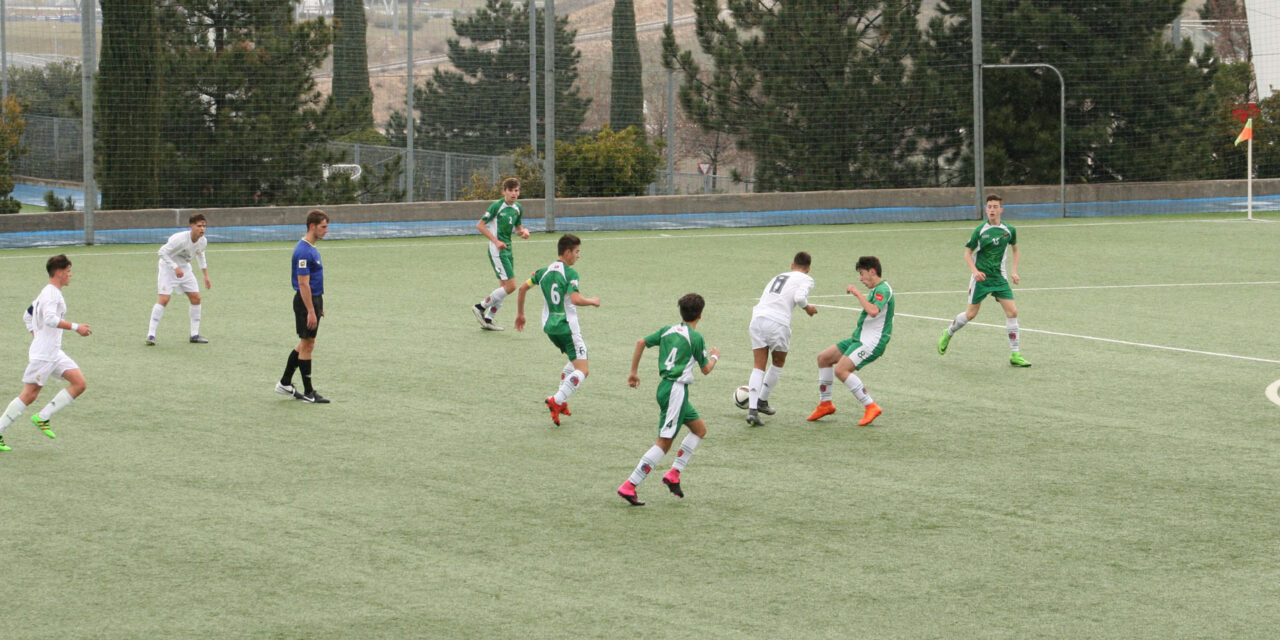
Every time we talk with other coaches about structuring the teams with younger players good enough to play a year up, it ends up with a heated argument. The coach of the younger team doesn’t want to lose their best player and questions the overall quality of the older team. The coach of the older team claims that this is the next prodigy, the best thing since sliced bread. Then the examples start to flow… Messi made his first appearance for Barcelona at age 16! Odegaard played for the Norway national team at 15!
Every soccer fan, hoping their team’s academy has the next Ronaldo
Playing a year up is the practice of playing in a soccer age group that is higher than a player’s chronological age. For example, a 12-year-old player competing in the under-14 age category would be playing a year up. This decision is usually made to expose young athletes to higher levels of competition and accelerate their development. Unfortunately, there is no scientific method or technology in soccer to determine if a player should play up or not.
The principle of forming the teams should be that the delta between the top player and the worse player on the team should be minimal. While there has to be some variation in the skill level, the only way to get optimal player development in a competitive environment is to have the players compete at a similar level. In a simple scenario, can you imagine yourself in practice right next to Haaland? (KDB, if you are reading this, it’s not for you)
When a Player Should Play a Year Up?
Essentially there are only two reasons for a player to be part of a team older than their age. One reason is if they can hold a place as one of the best players on the team of the age above. The other reason is if it stands out from the team of their own age.
The key player when playing up
I have seen cases when a coach has told me that without a player playing up, their team would fall apart. Initially, I didn’t trust him, but then that player missed a game and I saw the team losing 7:0. Sometimes, a youth team has only one player that is natural in a key position like a holding midfielder or central midfielder. Without them, the team really collapses and they are truly guaranteed their spot in every minute of every game. If the player is playing a key role in a key position in the year above, there is no reason to forcibly fit the player to play his own age because of an arbitrary rule based on the year they were born.
Too good for their current team
The other reason is if a player stands too much in the team their own age. Especially in smaller clubs, keeping the difference between the best and the worst player on the team is hard, if not impossible. If a player is too good for their age, the club has to move them to the team above or they will risk losing the player to a different club. To be clear, it is the club’s duty and it is likely that the coach will try to block that change. Nobody wants to lose their best player, but the club has to do it for the good of the player and for the good of the club.
When a Player Shouldn’t Play a Year Up?
There are strong arguments against a player playing up. Obviously, we are only talking about a case where the player has shown reasons to be considered playing up. We won’t entertain cases like “the schedule works better for the player” or “their best friend is on the older team”. But in the cases where we are not really sure, there are factors to consider and ways to mitigate them.
An average player when playing up
Let’s say that a player is one of the best players for their own age. However, they are a squad player when they would play a year up. That’s a perfect setup for the player to stay with their own team and play as a guest on the older team. For example, it is likely that the player will play the main role of a striker at their own age. However, to get decent playing time, they will be forced to the wings when playing up. The end result in a few years is a versatile player that can fit into multiple positions. We have read in many books of the greatest soccer players that they have played in different positions in their youth and that has contributed for their excellence. That is what we see as a result of a good soccer development program.
Wrong fit at the moment
There was a case when we invited a player to play up at a tournament. There was a last moment injury on the team, but we were happy for the player to have the opportunity to play. Unfortunately, the young player just didn’t fit in any aspect of the game or the event. They were scared and avoided eye contact with everybody before the game. During the game they were timid, avoiding the ball, and faked an injury within 5 minutes of their substitution. The pressure was just too much.
The complexity of managing youth sports is massive because a coach cannot know everything that happens in the players’ lives. The player might be intimidated by the older players or had a bad week or simply didn’t feel well physically. We won’t always know and that is ok. However, what we should have done is make sure we integrate some of these potential players into the team if we plan to invite them as guest players. We sometimes bring players to practices with the team year up to test the water. They sometimes see the intensity and don’t like it. Other times that drives them to perform even better. You guessed right – we invite the latter again!
Deciding whether to play a year up in soccer is a significant consideration for talented youth players and their parents. We always talk to parents before deciding if a player should play up. However, the final decision is on the club and the coach. We are responsible for the soccer development of the player. That is only one aspect of human development and it is a privilege to participate in that. Remember to always think of the long-term development of the player and it will work out.
About RondoCoach:
RondoCoach is a platform created by youth soccer coaches in the USA who are passionate about soccer and soccer development. We write for the players, the parents, and the coaches, to bring a better understanding of the game. We want to help the creation of soccer players and coaches by making the right decisions and having fun along the way.